
Searching the Lumpkin County Court Docket
A Lumpkin County court docket search begins with the right tool and the right details. The PeachCourt court search is the main published way to reach Lumpkin Superior Court case information. It also serves up documents. Pick the county and court, then search by case number or party. Georgia's E-Access directory lists approved providers too. It works as a directory with account notices rather than one free statewide results database.
- Identify whether the matter belongs to Superior, Magistrate, Probate, Juvenile, or Dahlonega Municipal Court.
- Open the court's published route and use the exact case number first; otherwise try a carefully checked party name.
- Match the court, caption, filing date, party roles, and case status before reading individual entries.
- Compare any calendar event with the latest notice or order, because a listed event is not always the final appearance date.
- Ask the proper clerk for a filed document or certified copy when an official record is required.
PeachCourt Is a Doorway, Not the Clerk
PeachCourt lets you search Superior Court cases, e-file, and pull documents for Lumpkin County. It is not the official file, though. Clerk of Superior Court Rita Harkins keeps the real record. The platform is only a doorway to it. Expect possible registration, uneven document coverage from court to court, and vendor fees. Two cautions apply. A missing image never proves a filing was skipped. A downloaded file is not a certified copy.
The Clerk's official page marks the e-filing milestones. Civil e-filing through PeachCourt has been mandatory since January 1, 2019. Criminal e-filing arrived April 1, 2020, and Magistrate civil e-filing becomes available July 1, 2026. Those dates only describe filing channels. Whether the public can see a given document still turns on the court and the filing. Your account, redaction, and access rules matter too.
Inside a Lumpkin County Court Docket
A Lumpkin County court docket is a running account of a case. It holds the case number, the court, and the style or caption. The assigned judge appears, and so do the parties with their roles. Attorneys, charges or claims, filing events, calendar events, and proceedings fill in the story, along with disposition information. What you actually see depends on the case type. Treat each entry as a dated event. When the exact wording matters, read the filed document itself.
| Case Number | The court's identifier; use it exactly as printed because no universal local format was published. |
|---|---|
| Parties | Names and roles such as plaintiff, defendant, petitioner, respondent, or attorney. |
| Docket Entries / Filings | Dated descriptions of complaints, motions, notices, orders, returns, or other activity. |
| Hearing Settings | Calendar events that may state a date, purpose, or status and still require current confirmation. |
| Court & Judge | The court class and assigned judge, both essential for routing a follow-up request. |
| Disposition | An outcome field or dated result; verify it against the corresponding order or judgment. |
A Filing Is Not an Outcome
- Filing
- A document received in the case, such as a complaint, accusation, answer, motion, or notice. Its presence does not establish that its assertions are true.
- Setting
- A scheduled court event. A reset, continuance, cancellation, or later order may change it.
- Disposition
- The recorded resolution of a charge, claim, or case stage. Read the date and related order before summarizing it.
- Certified copy
- A reproduction authenticated by the custodian. A screen result or ordinary portal download is different.
A docket pulls together a case's identity and its procedural history in one place. Provider materials support fields for the case number, court, and style or caption. The assigned judge, parties and their roles, attorneys, charges or claims, filing events, calendar events, proceedings, and disposition information get fields too. What you actually see depends on the case type. Treat each entry as a dated event. Then pull the filed document itself whenever the wording matters.
Courts That Keep Dockets in Lumpkin County
This distinction matters most in criminal and civil searches. A charge is not a conviction. A complaint is not a judgment. A calendar event does not prove a hearing ever took place. The docket gives you leads and chronology; filed orders and clerk certification give you stronger documentary confirmation.
| Court | Docket Covers | Where to Search |
|---|---|---|
| Superior Court, Enotah Circuit | Felonies, general civil, domestic relations, and other general-jurisdiction matters | PeachCourt and Clerk of Superior Court |
| Magistrate Court | Small claims up to $15,000, warrants, dispossessories, and other limited matters | Magistrate office, NCourt where offered, or clerk contact |
| Probate Court | Probate matters plus misdemeanor traffic, DUI, and game/fish violations described locally | Probate counter, telephone, or EZCourtPay for eligible citations |
| Juvenile Court | Juvenile matters governed by separate confidentiality and clerk rules | Dedicated clerk routing; public portal assumptions are unsafe |
| Dahlonega Municipal Court | City traffic, ordinance, and general misdemeanor matters within city jurisdiction | Municipal clerk at City Hall and eligible ticket-payment route |
The Justice Center Has Different Counters
The county public-buildings information helps place the modern Justice Center at 325 Riley Road in Dahlonega. The building contains separate court functions rather than one universal records queue: Superior Clerk services are in Room 108, Magistrate contacts use Room 109, and Probate is in Room 122. The Clerk's main number is 706-864-3736; Magistrate criminal matters use 706-864-7760; Probate and traffic use 706-864-3847.
The county's official public-buildings page provides useful Justice Center context:
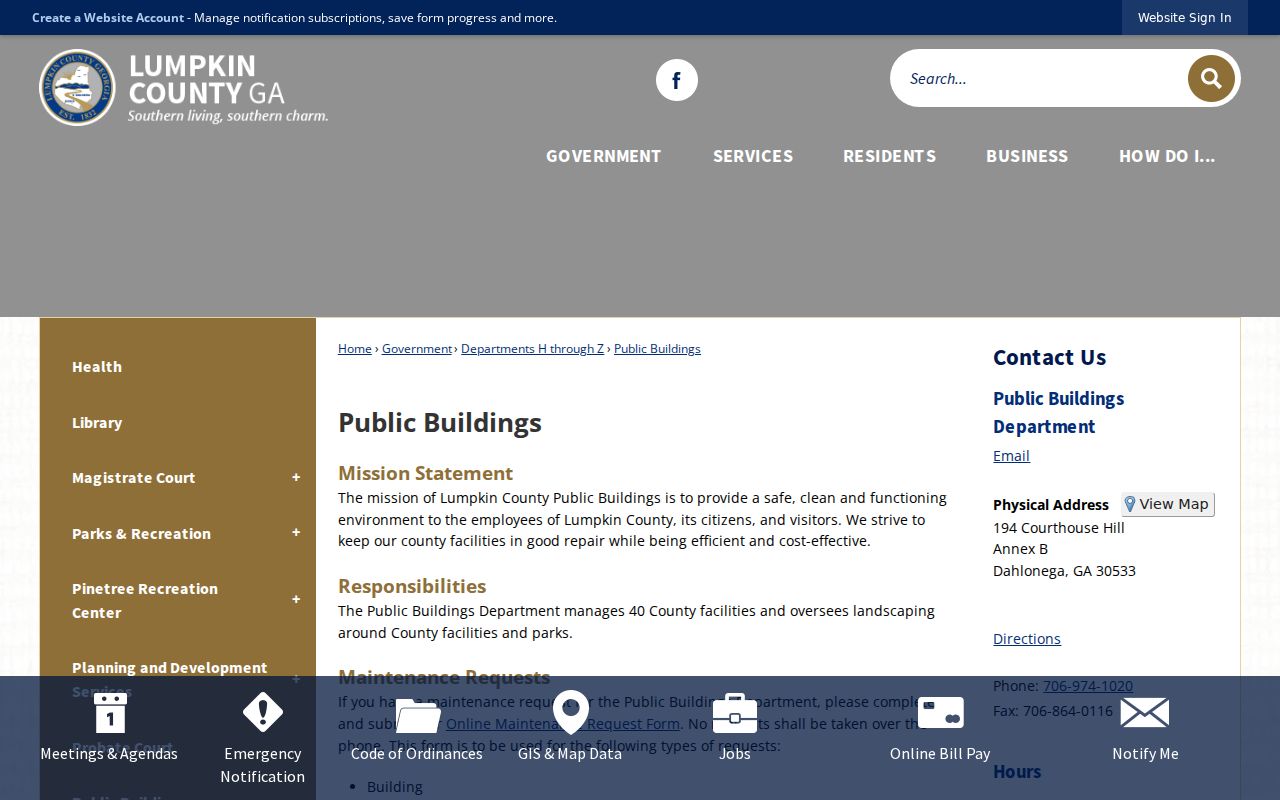
Getting the room and court name right saves a wasted trip. A Superior docket request, a Magistrate claim, and a Probate traffic question are simply not interchangeable at the Dahlonega counters. Call ahead whenever access, hours, or the proper office is unclear.
How to Find Court Dates and Settings
The county Resources page lists Trial & Arraignment Calendars. But the court posts no complete live settings table. Lumpkin County's Main Calendar is a civic-events tool. It offers date ranges, keywords, categories, “Show Past Events,” and subscription options. It is not a case calendar. Treat any case event or published calendar as a lead only. Then confirm with the summons, the notice, the latest order, a recorded court-information line, or the clerk.
A setting can be many things. It might be a calendar call, an arraignment, a motion hearing, a trial, or a filing deadline. A continuance or reset simply moves it. Neither one means the case was dismissed. The full Lumpkin County court dates walkthrough shows how to tell these sources apart. It also helps you verify a required appearance before you travel.
Weather Orders Can Move Enotah Dates
If a date may have changed: read the newest order and the latest docket entry, then call the court that sent the notice. An old listing or the county civic calendar will not settle it.
Judicial-emergency materials from September 2024 and January 2026 show how weather can close Enotah offices, suspend deadlines, and shift settings. This says nothing about any individual case. It simply explains why a docket chronology and a current appearance instruction can disagree while an emergency is in effect.
Public Access to Court Dockets
Georgia law and court rules back access while still shielding sensitive material. The Georgia Open Records Act covers county executive records. Yet Lumpkin's own request page sends Clerk of Court records to the Clerk. Court-specific rules also govern redaction, sealing, juvenile records, electronic filing, and courtroom devices. Public access does not mean every document sits online. Nor does it mean any file can be copied without restriction.
Key Rules:
O.C.G.A. § 50-18-71 - sets timing, copying, and cost rules for requests covered by the Georgia Open Records Act.
Uniform Superior Court Rule 21.6 - addresses protected identifiers and sensitive material in court filings.
Uniform Superior Court Rules 36.16–36.17 - govern electronic filing practices and responsibilities for sensitive information.
Georgia Rule 22 - concerns open courtrooms and rules for electronic devices and recording.
The Public Terminal and Online Access Are Different
The county's Notices page describes a no-charge Public Access Terminal in the Clerk lobby. The terminal makes the courthouse part of the electronic access path. Normal filing, service, outside-location e-filing, vendor, document, or certification fees can still exist. Ask what the terminal shows. Ask whether the document you want is available, since "public access" does not promise a free image. The county's Clerk office page illustrates this mixed counter-and-provider arrangement:
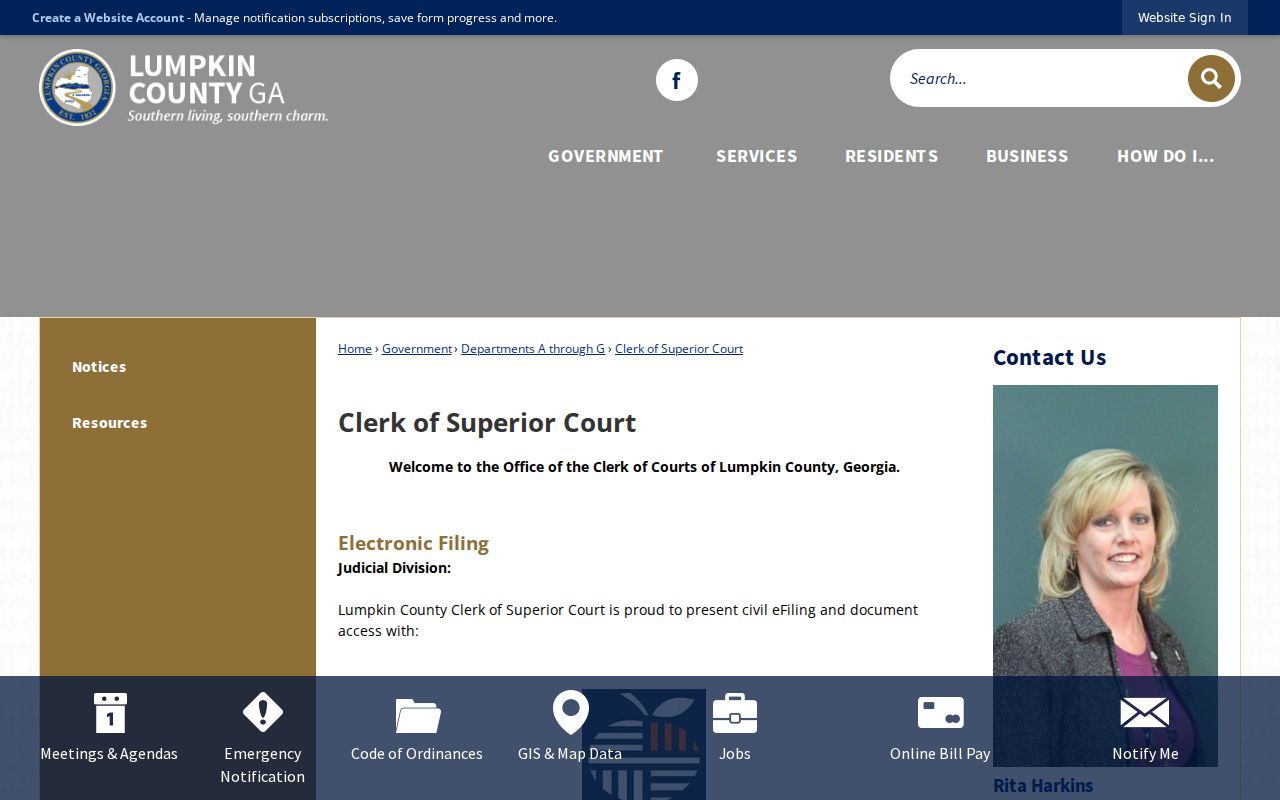
Try PeachCourt first. If the Lumpkin County docket you need is missing there, use the lobby terminal or ask the records staff for a copy.
Docket Records at the Clerk's Office
Rita Harkins serves as the elected Clerk of Superior Court for Lumpkin County. Her office splits its work across desks. These cover civil, criminal, juvenile and adoption, jury and post-judgment, and Magistrate civil. A strong records request names the court and the case number. Include the parties, the document or docket you want, the filing date if you know it, the format you prefer, and whether you need certification. Note that the county's general Open Records form does not cover Clerk of Court records. The official Clerk directory lays out how the roles divide:
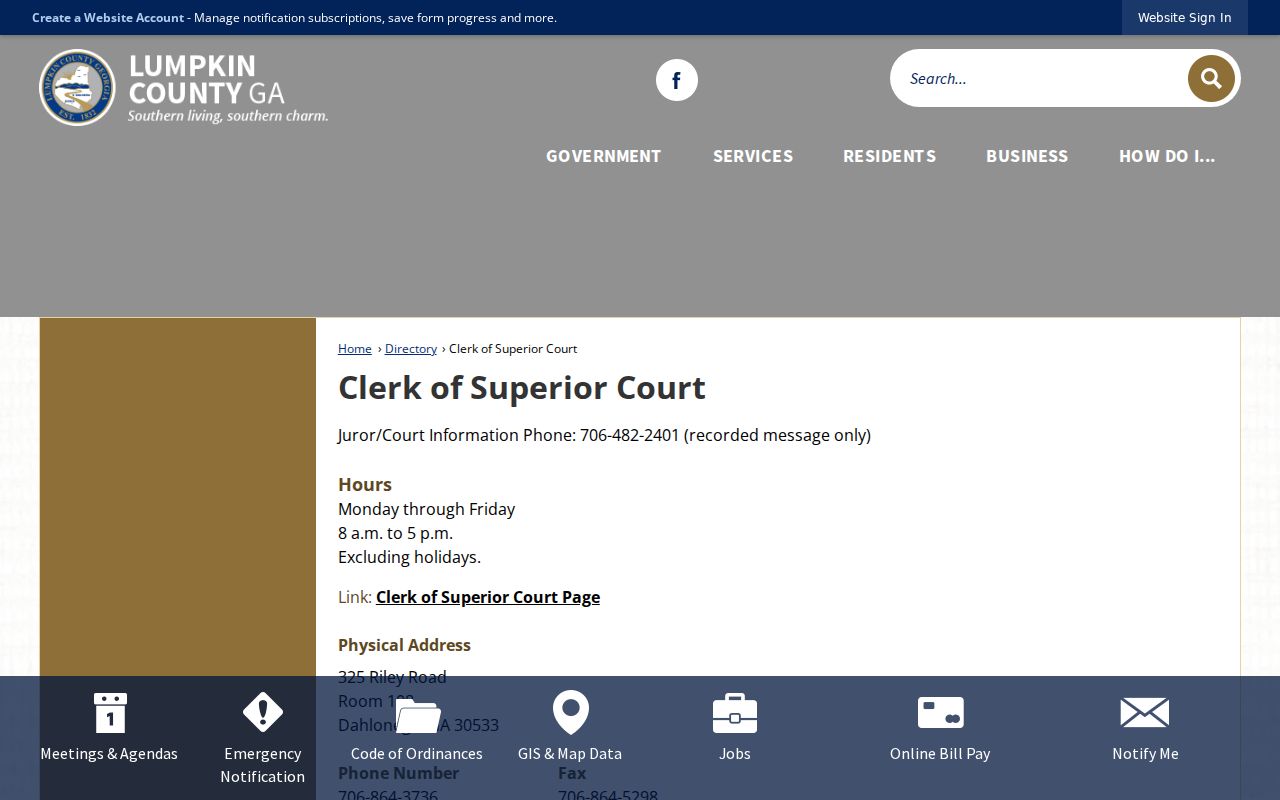
Getting the division right keeps juvenile, adoption, certified-copy, and post-judgment questions out of the wrong queue.
Lumpkin County Clerk of Superior Court
325 Riley Road, Room 108
Dahlonega, GA 30533
706-864-3736
From the 1836 Courthouse to Electronic Files
Lumpkin County was created in 1832. Dahlonega won the county seat in 1833. The Old Courthouse on the square went up in 1836, according to the county's history page. That 1836 building now operates as a state-run gold museum. Court business long ago moved on. Today the Justice Center handles hearings, and records are scanned. A public terminal gives docket access, and separate electronic systems carry the files.
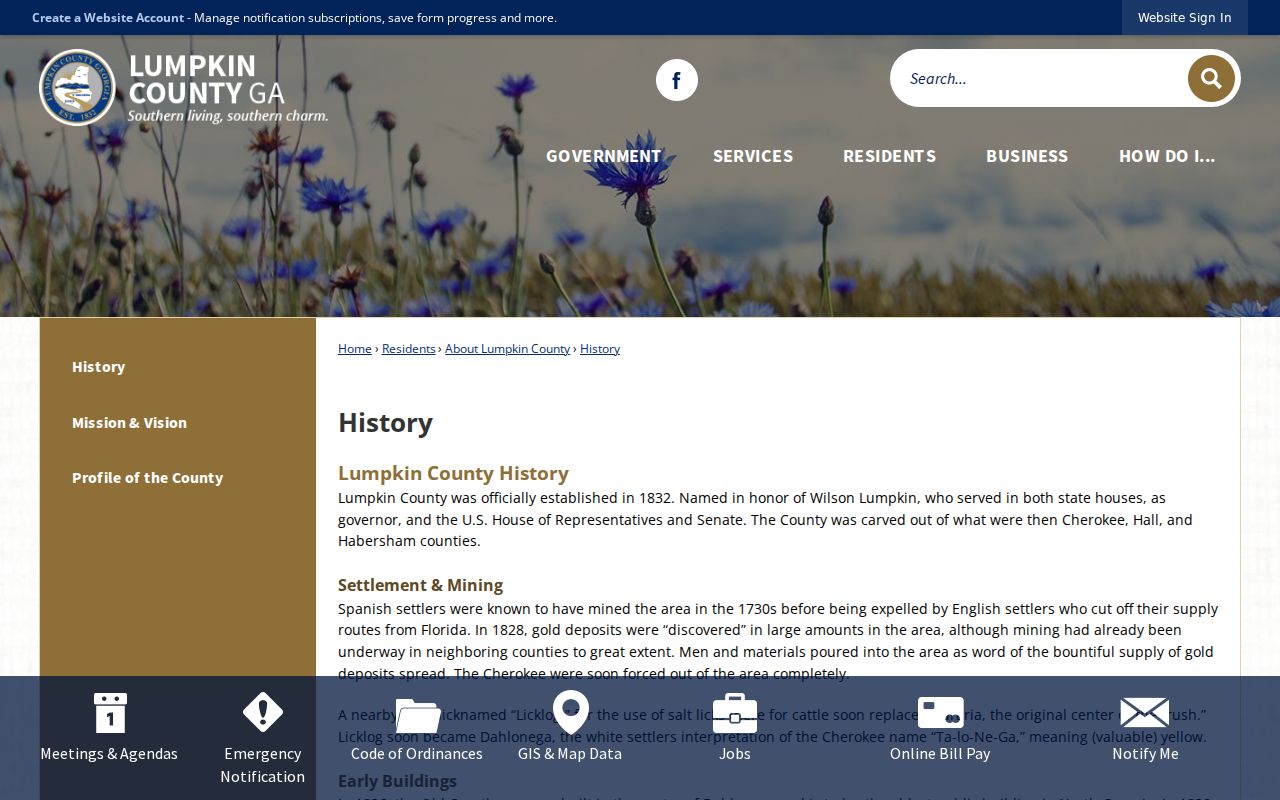
That history shapes how you search. Old records may sit with a custodian, while modern Superior filings are indexed through PeachCourt. Plats became required to file through GSCCCA e-filing in 2017, Superior civil followed as mandatory in 2019, criminal e-filing arrived in 2020, and Magistrate civil e-filing opened up in 2026.
Lumpkin County Court Dockets by City
Lumpkin County has one incorporated city with a municipal court: Dahlonega, home to 7,537 people in the 2020 Census. Its Municipal Court sits at City Hall and takes city traffic tickets, ordinance cases, and general misdemeanors, meeting once a month. The city posts no public municipal docket database. So a docket search starts with the municipal clerk, not the county civic calendar.
Dahlonega Docket Search
7,537 (2020 Census) · Municipal traffic, ordinance, and misdemeanor route at City Hall
Three Layers of Local Cost
Searching a Lumpkin County court docket can trigger three separate charges. One is the filing or service fee tied to the court process itself. Another is a provider charge for electronic document access, and a third is the copy or certification fee from the office holding the record. Keep them distinct. PeachCourt publishes provider pricing that varies by route, Magistrate posts its filing and service costs, and Probate sets its own copy schedule.
| Layer | Local example | Check before paying |
|---|---|---|
| Filing and service | Magistrate Statement of Claim with one defendant: $69 filing plus $50 service | Current Magistrate cost table and number of defendants |
| Provider access | PeachCourt document access may involve per-page and convenience charges | Live account and checkout terms |
| Copy or certification | Probate schedule: $1 ordinary page, $10 certified copy, $15 exemplified copy | The actual custodian; Probate rates do not govern every court |
Superior, Magistrate, Juvenile, and Dahlonega municipal courts publish no single current copy schedule. Ask for an estimate, and say whether you want ordinary, certified, or exemplified copies before paying.
Federal Cases Leave Lumpkin County
Federal cases never show up in Georgia county portals. Lumpkin County falls under the Northern District of Georgia's Gainesville Division, whose public counter sits at the Sidney O. Smith Federal Building and United States Courthouse, 121 Spring Street SE, Room 201, Gainesville. Federal district and bankruptcy dockets run through PACER and CM/ECF, and appeals go to the Eleventh Circuit. PeachCourt, the county public terminal, NCourt, and EZCourtPay cannot fill that gap. The reverse holds too: PACER will not find a Lumpkin Superior or Probate case. Trust the court named on your filing or notice, and treat CourtListener and RECAP as a coverage-dependent alternative rather than the official federal record. The official Lumpkin County home page offers a solid local-government starting point:
It points you to local offices, but a federal docket still lives with the federal clerk and PACER.
Map and Directions to the Lumpkin County Justice Center
Superior Court records are kept at the Clerk of Superior Court's office, Room 108 of the Justice Center at 325 Riley Road in Dahlonega. Magistrate Court shares the building in Room 109, and Probate Court sits in Room 122, so knowing the room number before arrival saves a stop at the front desk. The Justice Center replaced the 1836 Old Courthouse on the square, which is now a gold museum rather than an active court building.
Lumpkin County Clerk of Superior Court
325 Riley Road, Room 108
Dahlonega, GA 30533
706-864-3736
Monday through Friday, 8:00 a.m. to 5:00 p.m., excluding holidays
Lumpkin County Magistrate Court
325 Riley Road, Room 109
Dahlonega, GA 30533
706-864-7760
Monday through Friday, 8:00 a.m. to 4:30 p.m.
No official parking map, security handbook, or same-day copy procedure was located for the Justice Center, so confirm ID, device, and accessibility logistics with the clerk before the trip. This is a separate building from the Dahlonega Municipal Court at City Hall and from the federal courthouse in Gainesville.