
Lumpkin County Court Calendars Explained
The county's Resources page carries a tab labeled Trial & Arraignment Calendars, but it does not offer a current, case-by-case settings table you can search. A stale or empty reference signals a publication gap. Hearings have not stopped. Your setting may instead appear on a notice, be announced at calendar call, show up as a PeachCourt event, or come straight from the court office by phone.
The path depends on the court. Lumpkin County Superior Court belongs to the four-county Enotah Judicial Circuit and uses scheduling channels that differ from Probate traffic, Magistrate, Juvenile, and Dahlonega Municipal Court. The Superior Clerk is the main Superior contact. That office does not keep every local calendar.
Lumpkin County Trial Calendar Gap
The Lumpkin County court Resources page is the natural first stop, since it lists trial and arraignment calendars alongside jury information, grand jury presentments, schedules, and forms.
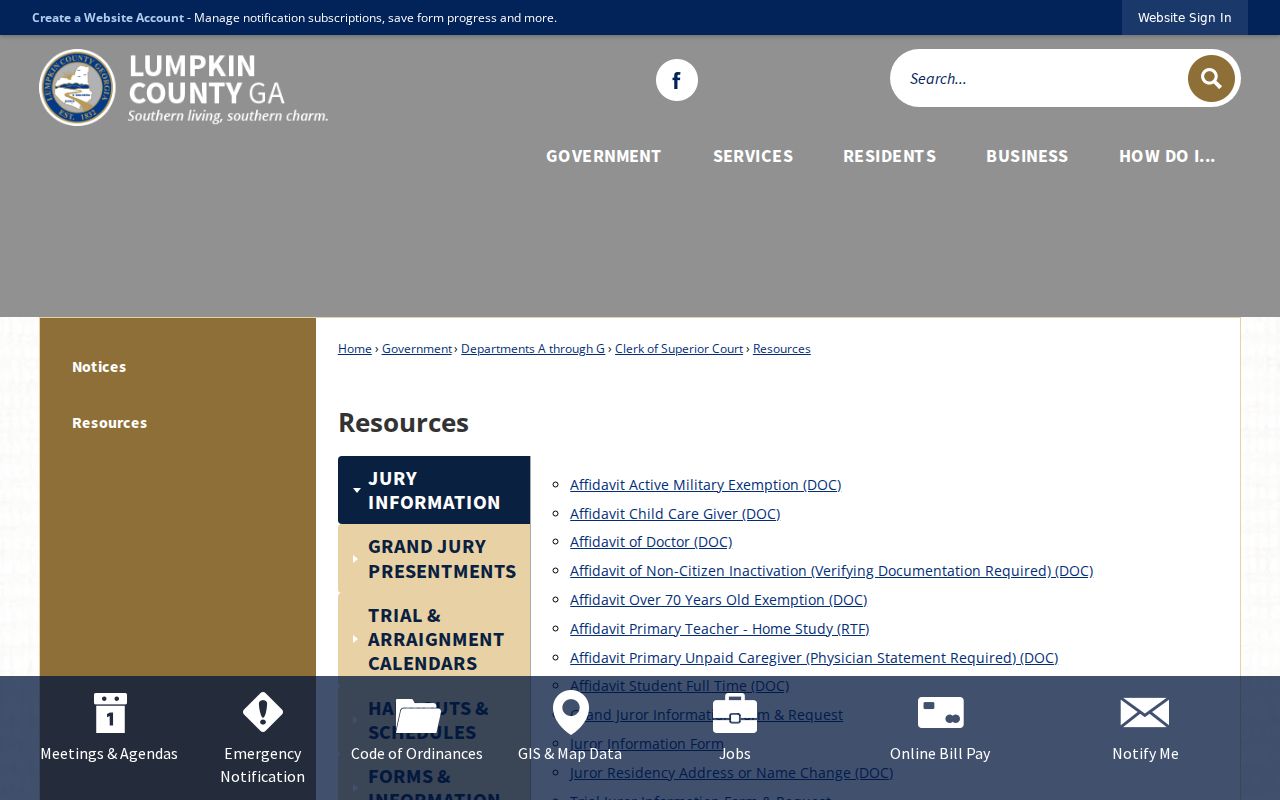
That page confirms the right county source. It is not a complete live list when no current dated calendar appears. Let the clerk or the latest notice give the final answer.
Publication gap: An empty calendar area does not cancel a hearing or prove that no setting exists.
Finding Your Lumpkin County Court Date
Start at the source closest to the case. Pull the exact case number and court name from your paperwork. A Probate traffic date does not belong at the Superior Clerk, and a Dahlonega city date will not appear on the county events calendar.
- Read the latest summons, citation, notice, filed order, or attorney message for the named court and date.
- Check the Resources page and, for Superior matters, PeachCourt for any supplied calendar event.
- Call the correct office: Superior Clerk at 706-864-3736, Magistrate criminal at 706-864-7760, Probate or traffic at 706-864-3847, or Dahlonega Municipal at 706-482-2720.
- Use the recorded Court Information line at 706-482-2401 for schedule announcements, while recognizing it is not a records clerk.
- If needed, ask at the proper counter. Superior, Magistrate, and Probate contacts are at 325 Riley Road in Rooms 108, 109, and 122; city matters go to 465 Riley Road.
- Compare the answer with counsel, a posted calendar or docket call, and the latest court notice before appearing.
Georgia Courts E-Access works as a provider directory, not a statewide settings calendar. Lumpkin County offers no official mail, fax, email, universal text alert, or court-calendar subscription method.
Lumpkin County Civic Calendar Controls
The Lumpkin County Main Calendar supports list, week, and month views, date filters, search terms, a past-events option, print, notifications, and iCalendar subscription controls.
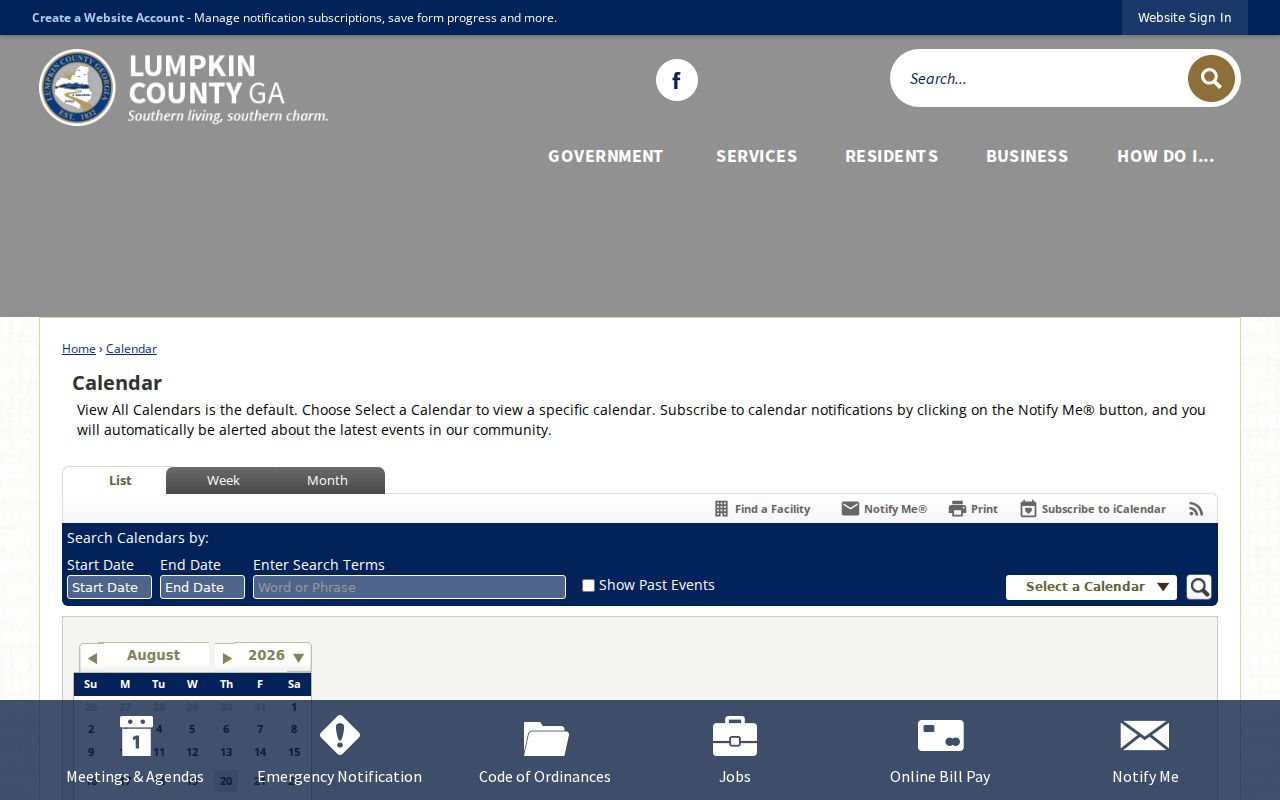
Those controls govern a civic-events calendar. It shows no case numbers, parties, judges, courtrooms, setting types, appearance status, or continuances. "Show Past Events" only changes the website display; it proves neither that a hearing occurred nor that a case was disposed.
How to Read a Lumpkin Court Setting
Read a court setting as a set of fields together. A date alone is unsafe. Several court classes operate in Lumpkin County, one day can hold several calendars, and an event may describe a deadline rather than an appearance.
| Date | The day on the latest notice; verify that no later order replaced it. |
|---|---|
| Time | The start time, which may be a calendar-call time rather than a unique hearing time. |
| Courtroom | The room and building stated by the court; no full public room schedule was located. |
| Judge | The assigned or presiding judge where supplied; assignment alone may not identify who hears one setting. |
| Setting Type | Arraignment, plea, motions, calendar call, civil non-jury hearing, jury trial, or another defined event. |
Verify the case number, court division, and appearance instruction too. A traffic payment date is not automatically a required appearance date.
Lumpkin Court Setting Terms
Lumpkin County publishes no complete calendar-code sheet, so rely on plain descriptions rather than invented abbreviations.
Calendar call A scheduling or case-management session that may cover several cases.
Special-set jury week A trial period on a revised schedule. The Clerk's 2026 staffing material describes it.
Calendar event PeachCourt's term for a scheduled item supplied on a case page. It is not a guarantee of a complete calendar.
Continuance or reset A court-authorized move that requires confirmation of the replacement date.
Deadline A date for filing, payment, or another act. It may not involve a courtroom appearance.
Continuances, Resets, and Cancellations
A reset or continuance makes the old date an unreliable instruction. The change may appear in an order. It may also surface in a later notice, a docket proceeding, or an updated calendar event. It may not reach every public channel at once. Ask for the new date, time, court, and appearance instruction. Note who gave it to you.
Local schedule pressure explains why verification matters. A 2026 Clerk staffing document describes three regular Superior judges. It also lists two senior judges, special-set jury weeks, criminal calendar calls, plea and motions dates, and civil non-jury hearings. None of that is grounds to assume your case moved. Only the court can continue or cancel a setting.
Lumpkin County Weather Date Checks
Weather and judicial emergencies can close offices, reset filing deadlines, and shift court dates with little notice. Lumpkin County worked under a local judicial-emergency order in September 2024. Enotah issued another one during a January 2026 winter storm. A saved event or a page you pulled up weeks ago will not help you on a closure day.
Before you drive anywhere, check the Georgia Courts emergency-order page along with any current Enotah order. Then call the office that handles your case. One warning: a closure does not automatically move every Lumpkin County case to a fixed new date.
If You Miss a Lumpkin Court Setting
Contact the office that owns the case right away. Give the exact case or citation number, and ask what the docket shows and which process applies. Tell counsel at once if you have one. Never pick a new date yourself, and never assume payment or a phone message lifts a warrant or other consequence.
Missed a setting? A missed required appearance can lead to court action, including a bench warrant where the case and court permit it.
Call the correct clerk at once and ask for the current status and official next step.
Legal questions should go to a Georgia-licensed attorney or the court, since clerk staff cannot give legal advice.
Confirming Lumpkin County Dates
Confirm a Lumpkin County court date by pulling the details together. You want the court name, case number, party or citation, the type of setting, plus the date, time, and place. For Superior Court matters, the Clerk of Court and PeachCourt are the two main routes. Probate, Magistrate, Juvenile, and Dahlonega Municipal matters each keep their own channel. Check the right one. If an event is missing online, that alone proves nothing. PeachCourt coverage varies by case, and its Resources tab does not show a full list. The civic calendar is not a docket either. When a public view and a written notice disagree, save both. Ask the clerk's office which instruction stands. Skip the general Open Records Act form for date questions. It excludes Clerk requests and is not the fallback here.
Lumpkin Calendar Verification Notes
Keep a short verification note with your case papers. Jot down the office you called. Include the date and time, the staff role, and the details given. Then compare that against the newest written notice. This pays off when a calendar call, a plea date, a motions date, and trial week all crowd together. Each label marks a different procedural point in the court docket. Before heading to the Justice Center, confirm the current parking, identification, device, accessibility, and entry rules. The county publishes no complete local security handbook. Rely on the court's own current instructions rather than the events page. A public courtroom and a public docket are different forms of access. Georgia Rule 22 supports open courtrooms and reasonable device use. It does not permit copying protected filings or ignoring a judge's specific directions.
Lumpkin Court Calendar Pressure
The Enotah Judicial Circuit schedule sits in a wider frame. It is bigger than a single Lumpkin County courtroom. Enotah covers Lumpkin, Towns, Union, and White counties. Its official 2025 Judicial Workload Assessment reports three circuit judges. It also reports 1,377 cases per judge, a workload value of 2.9, and a three-year circuit average of 2,121 criminal defendants and 1,908 civil matters. Those are four-county figures, not Lumpkin-only case counts. They explain why multiple calendars and revised schedules appear. But they cannot predict when one hearing will occur.
For the closer operational picture, look at the Lumpkin Clerk's 2026 staffing request. It says schedules grew during 2025 and stayed heavy because of a COVID-related backlog. Three regular Superior judges get help from two senior judges. Their workload spans separate calendars, special-set jury weeks, criminal calendar calls, plea and motions dates, and civil non-jury hearings. So one case history can carry several legitimate date labels. The newest court order or notice controls over an older calendar event.
PeachCourt can show both calendar events and docket proceedings when the court supplies them. Treat those as two different field families. A calendar event points to scheduled activity. A docket proceeding records activity in the case chronology. Neither label proves an appearance happened. It does not show that a matter ended, or that a later reset was entered everywhere at once. When timing is unclear, give the clerk the court name and exact case number. Ask which listed date is current.